
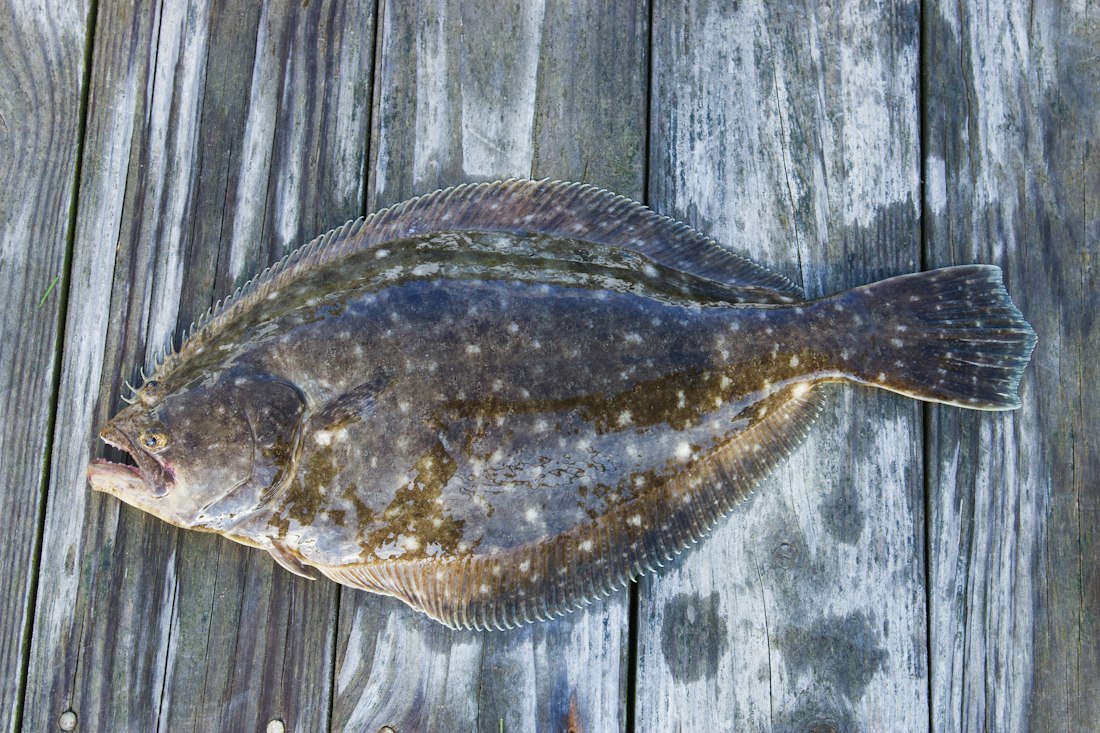
engawa /en·ga·wa/noun · from Japanese 縁側
- A narrow wooden veranda along the outside of a traditional Japanese house. A famous spot for sunbathing.
- The muscle that moves the dorsal and anal fins of flounder and other flatfish. Rich, springy, and much loved as a sushi topping.
This encyclopedia deals mainly with ②. Reading it on a veranda (①) is encouraged.
1Where the name comes from
The strips run long and narrow along the fins, much like the wooden veranda (engawa) along a Japanese house, which is said to be how the name stuck. Whether engawa itself enjoys sitting in the sun has not been confirmed.
2Where is it?
Along the base of the dorsal and anal fins, one strip top and bottom on each side: four in total. For the fish, it is the engine that drives the fins. Small strip, big job.
3Why is it so good?
It's a muscle that works the fins for life, so it is firm with a springy bite. It's also well marbled, so the sweetness spreads the more you chew. Sear it and the fat melts into something toasty and new.
4History: from scraps to star
Engawa is said to have started as the part left over, and often thrown away, when flatfish were filleted. Today it is a conveyor-sushi standard: a true rags-to-riches cut.
5Engawa at sushi chains
Olive flounder engawa is scarce, since each fish gives so little, and it is a luxury item. So sushi chains mainly use engawa from large northern flatfish such as Greenland halibut and Kamchatka flounder. Bigger fish, thicker strips, more marbling.
6Telling flatfish apart
Japanese has a saying: “hirame on the left, karei on the right.” Lay the fish with its belly toward you: eyes on the left means olive flounder (hirame), eyes on the right means a righteye flounder (karei). There are exceptions, like the starry flounder, so even fish have their rule-breakers.
Bonus fact: both start life with an eye on each side, like any other fish. As they grow, one eye gradually migrates to the other side.
7From sea to sushi
- Grows up in deep northern seasGreenland halibut live several hundred to around 1,000 m down in the North Atlantic and North Pacific.
- Arrives at our Shandong plantsThe raw fish go to our plants in Shandong, China, where raw-material storage holds 5,500 tonnes.
- Hand-cut, piece by pieceSkilled staff cut each strip by knife, to the size and spec each customer orders.
- Quick-frozen and double-checkedTunnel freezers rated at 1,000 kg an hour lock in freshness, and every batch passes sight-and-touch checks plus X-ray and metal detection.
- Off to JapanShipped frozen to Japan and onto the conveyor belt. Almost at your plate.
8Fun facts
Even a big Greenland halibut gives only four strips. Every plate is a small luxury.
A quick flame melts the fat for a toasty, melting bite.
Sushi bars abroad usually just call it “engawa”.
Chinese uses 裙边 (“skirt edge”) for the prized rim of a soft-shell turtle's shell, too.
9The Engawa Quiz
If you've read this far, you should ace it.
Q1How many engawa strips does one fish give?
Q2Where does the name “engawa” come from?
Q3What fish do sushi chains mainly use for engawa?
Q4“Hirame on the left, ___ on the right.” Fill in the blank.
10See also
- Seafood guide: Greenland halibut
- Seafood guide: Kamchatka flounder
- Seafood guide: Atlantic halibut
- Products: engawa & flounder series
- Quality: hygiene and inspection
Edited and published by JCCT Trade Co., Ltd., the leading company in engawa